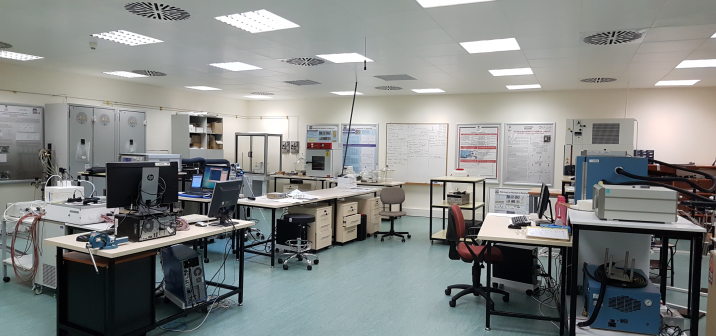

Moisture measurements in gases (and air) and solids are important in many fields, from ensuring human health and comfort to energy, food, pharmaceuticals, battery and electronics production, weather and climate.
The main purpose of the humidity laboratory is to establish, maintain and expand the infrastructure to perform measurements of moisture and humidity qualities, especially relative humidity of the air, absolute humidity, dew-point and dew-point temperatures, partial pressure, fraction and ratio of water vapor, amount of water in various gases, amount of water in solid state and powdered materials (including volatile components), etc. in a traceable manner to SI units and/or related standards. In addition, traceable measurement of air temperature according to ITS-90 (International Temperature Scale-1990) is also within the scope of this laboratory. Accurate measurement of air temperature is of great importance in relative humidity measurements. Currently, the uncertainty of air temperature measurements in the laboratory has been reduced to 0.07 °C between -10 °C and 70 °C and 0.2 °C (k=2) between 70 °C and 90 °C, and efforts are underway to further reduce these uncertainties. For example, an error of 1 °C in air temperature leads to an error of over 5 %rh in relative humidity measurements.
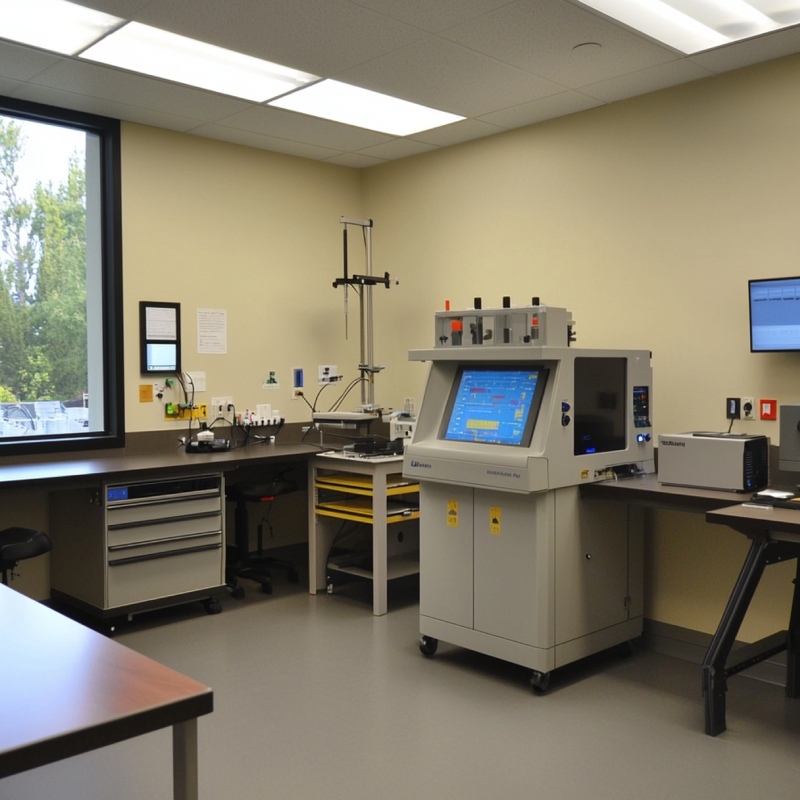
Currently, traceable calibrations to SI units are performed for a variety of hygrometers, humidity sensors, humidity and temperature data loggers and transmitters, dew-point moisture meters, ambient conditions loggers and air temperature thermometers with and without indicators (software connected).
In addition to the measurement of humidity and air temperature qualities, the Humidity Laboratory also works to create environments with a certain relative humidity at a certain air temperature. Environmental conditioning and object exposure tests according to various standards and protocols are also carried out in this laboratory.
Another purpose of the moisture laboratory is to perform traceable and highly accurate moisture measurements. In the laboratory, the water content/moisture of various solids (including powders) can be measured by various methods (primary level and SI-unit traceable water content measurement, mass loss by drying,
v-KF titration, etc.) determination and certification are also within the scope of this laboratory. In particular, studies are being carried out for high accuracy moisture measurements of cereal crops. New traceable (and non-contact) measurements for soil moisture measurements are among the objectives of the laboratory.
In addition, the real-time measurement system for the determination of trace water content in ultra-dry (<50 ppb) air is used for special purpose measurements, especially in space applications, pharmaceutical and electronics industries.
In addition, trainings and consultancy services are provided on Moisture and Moisture measurements, uncertainty calculations and other similar subjects.
The laboratory participates in various international key comparisons, bilateral inter-laboratory comparisons and multinational research projects, ensuring that the services provided are of international quality. In addition, inter-laboratory comparisons are carried out within the country to ensure traceability and measurement accuracy on a national scale.
Currently, the laboratory is a member of BIPM working groups on Moisture and Humidity, EURAMET, COOMET, GULFMET and SMIIC technical committees.
Traceable calibrations:
Training and counseling:
Within the scope of humidity metrology, first level relative humidity and air temperature measurements are performed at atmospheric pressure using a reference dew-point humidity and air temperature meter at air temperatures ranging from -10 °C to 70 °C at relative humidity values between 11 %rh and 95 %rh.
The second level relative humidity and air temperature measurements are performed at atmospheric pressure using a reference dew-point humidity and air temperature meter at air temperature values ranging from 10 °C to 90 °C at relative humidity values between 20 %rh and 90 %rh.
Air temperature measurements are made at -10 °C to 70 °C at the humidity source and -40 °C to 100 °C at atmospheric pressure in air conditioning cabinets.
Dew-point measurements are carried out at atmospheric pressure in the cabin or in the air line at air temperatures ranging from -30 °C to 60 °C dew-point and -10 °C to 70 °C dew-point.
-Dew point measurements between -80 °C and 10 °C are performed at atmospheric pressure using an air line and a reference dew point moisture meter.
Within the scope of moisture measurements in the material, moisture content of sawdust, paper and similar materials compressed by Loss-on-Drying method is measured in the range of 2.7 %mc to 26.6 %mc.
| System | Capacity |
|---|---|
| Primary level dew-point temperature measurement system | Dew/dew-point temperature range of -80 °C to 10 °C at atmospheric pressure |
| Primary level relative humidity and air temperature measurement system |
Atmospheric pressure;
-35 °C to 60 °C dew/wet-point temperature range -10 °C to 70 °C air temperature range Relative humidity range from 11 %rh to 95 %rh |
| Secondary level relative humidity and air temperature measurement system |
Atmospheric pressure;
-40 °C to 180 °C air temperature range With 10 %rh in the air temperature range 10 °C to 95 °C 95% %rh relative humidity range |
| Moisture content measurement system in the material range from 2.7 %mc to 26.6 %mc | 2.7 %mc to 26.6 %mc range |
* Services in our laboratory are provided under ambient conditions of 21 °C ± 3.0 °C temperature and (45 ± 15) % rh humidity values.
Connection: https://www.prispectemp.ptb.de/home
Connection: https://www.sommet-project.eu/home
Connection: https://www.prometh2o.eu/
Connection: https://www.meteomet.org/
Email: ume@tubitak.gov.tr
Phone: 0 (262) 679 5000