

TÜBİTAK National Metrology Institute has completed two of the five projects carried out to combat the COVID-19 outbreak and made significant progress in three of them.
With the awareness and responsibility of its role in the country's metrology system, TÜBİTAK UME, which continues its efforts to develop, maintain and ensure the traceability of national measurement standards, continues to make every effort to accelerate the dynamics of the war waged by the nation by developing projects to combat the pandemic with its rich infrastructure and well-equipped staff.
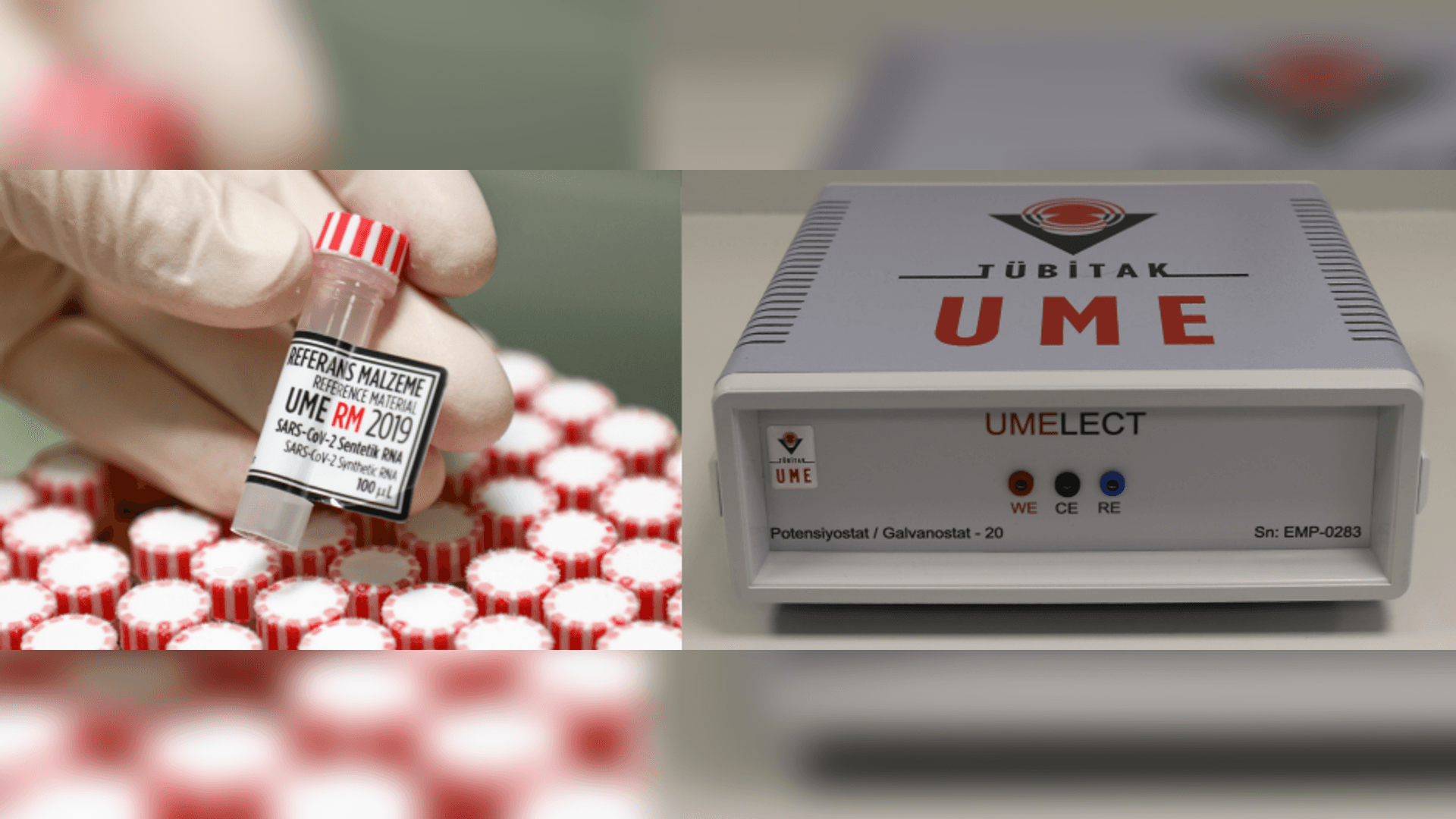
Carrying out 5 different projects within the scope of combating the COVID-19 pandemic, TÜBİTAK UME managed to complete one of them in as little as 3 months. With the project support of the Eastern Marmara Development Agency (MARKA), RNA-based diagnostic kit reference materials for the rapid and reliable diagnosis of SARS-CoV-2 virus were produced in just 3 months and offered for use in 2 different forms as "frozen" and "lyophilized powder".
In addition to guaranteeing the quality of PCR tests performed with reference materials produced with domestic and national facilities, the most important advantage of the lyophilized reference material is that it does not require any cooling process during transfer. In this way, the distribution of lyophilized reference material to stakeholders inside or outside the country can be done easily without the need for dry ice.
The RNA-based Reference Materials produced will be used for internal quality control by all laboratories in our country for the correct diagnosis of the virus, and can be added to kits as positive quality control material by our country and foreign kit manufacturers. With the infrastructure established at TÜBİTAK UME, new RNA-based reference materials will be in a position to be produced in a very short time if the virus mutates, if a test is desired to be developed in a different gene region or if a new virus emerges.
COVID-19 Hastalığı için Voltammetrik Sensör & Cihaz Üretimi Projesi kapsamında da SARS-CoV-2 virüsünün spesifik proteinlerinin tayini için belirtilen iş paketleri tamamlanarak ulusal tanı kiti, cihazı ve yazılımı üretildi. Geliştirilen yöntem, sensör ve cihaz 30 pozitif ve 80 negatif gerçek hasta örneklerinde denendi ve RT-PCR ile karşılaştırıldığında %85’in üzerinde bir doğruluk elde edildi. Geliştirilen bu sistem, yazılımına çok sayıda örnek ile analizler sonrasında yapılacak küçük eklemelerle ulusal ve uluslararası ölçekte ölçüm yapan bütün laboratuvarlar, hastaneler ve tesisler için bir cazibe haline gelebilecek. Bu hastalığın şu an ve ilerdeki zamanlarda tayin edilebilmesi ve kit/cihaz üretiminin sağlanması ülkenin maddi olarak dışa bağımlılığını azaltacak ve mevcut veya ilerde çıkabilecek başka hastalıkların tanısında yeni kit ve cihazların üretimine ışık tutabilecek.
Some projects for the detection and treatment of the virus with different measurement methods are also nearing completion.
In the Optical and Electrochemical Biosensor Development Project for the Diagnosis of COVID-19 Disease, which was initiated to add a new one to the measurement methods in the literature and to provide an alternative method to the production of different kits and devices, 3 of the work packages specified for the determination of specific proteins (antigen) of the SARS-CoV-2 virus were successfully completed.
Within the scope of the project, synthesis and characterization studies of gold nanoparticles of different sizes were carried out as the first target. The synthesized gold nanoparticles of different sizes were characterized using various methods. Afterwards, spike antibodies belonging to SARS-CoV-2 were modified on the surface of gold nanoparticles by different chemical methods and then characterization was carried out and spike antigens of the virus were successfully determined by both optical and electrochemical methods. In the next phase of the project, it is planned to obtain better optimization conditions by trying different chemical methods to improve both the detection limit and detection time.
In the Development of Thermal and Optical Based Systems for the Detection of Pandemic Diseases Project, which is carried out to develop methods and systems for the traceable calibration of non-contact thermometers used in the first detection of COVID-19, the entire infrastructure for the traceable calibration of both forehead thermometers and thermal cameras has been made ready and services have started to be provided. In addition, the process of developing reference fixed points for the calibration of these thermometers continues.
In the project, which covers studies on the detection of transparent nanoparticles in virus and bacterial sizes by optical methods, the photothermal test setups of the system have been completed and the particle detection phase with optical force has started.
Finally, in the Virus (COVID-19, SARS, MERS, etc.) Spread Reduction Project, which is carried out in cooperation with Istanbul University Cerrahpaşa Faculty of Medicine in order to characterize the virus spread dynamics, especially COVID-19, with high accuracy, to investigate a method to reduce the spread and to design a prototype device, important results were achieved in the measurements carried out on reducing the spread of the virus with the infrared (IR) technique. Work on the creation of a system for monitoring and measuring airborne droplets with a fast and high-resolution camera and laser system and monitoring the character of the spread of the virus, and on reducing the spread of the virus with the microwave (MD) technique continues unabated.
Apart from the two finalized projects, one of the three ongoing projects is expected to be completed and put into use by the end of 2021 and the other two in the first months of 2022.


